


Strength Training Principles for Enduro & Downhill Mountain Bikers
- Jonathan Deerman

- Nov 2, 2025
- 5 min read
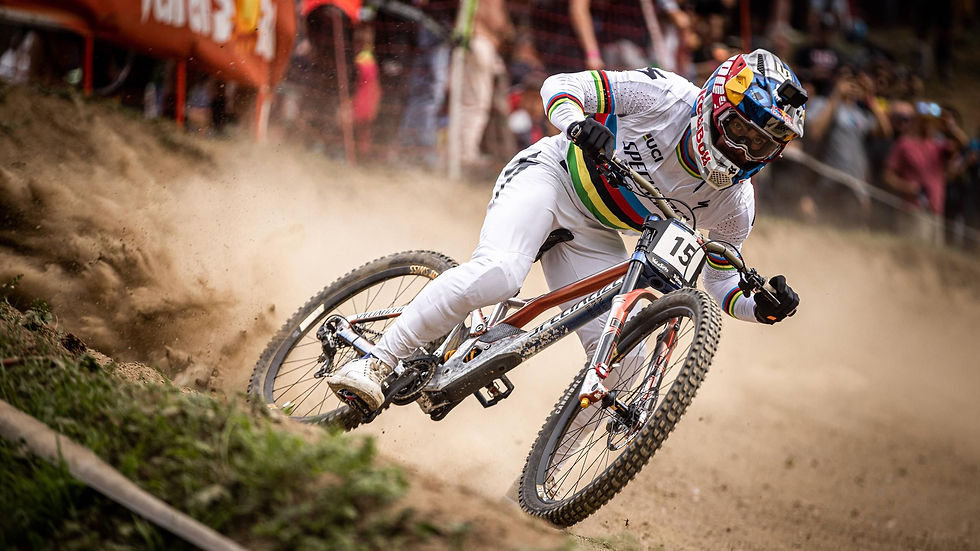
Downhill mountain bike racing requires total body strength, power, and endurance as races last up to five minutes often requiring intermittent bursts of peak wattage output to the pedals while navigating a course littered with obstacles battering the rider with high g-forces requiring immense upper body strength (Hurst et al., 2018). Grip strength endurance has been shown to be the second most influential element of the rider with riding skill being the most important (Chidley, et al., 2015). “Grip strength endurance” was calculated as the average force produced on a dynameter over 5 minutes. Therefore, using RT to increase grip strength is a high priority.
Secondly, since the way a rider transfers power to the pedals requires total body power to pull up on the handlebars to push down on the pedals, similar whole body power exercises ought to be implemented as short bursts of <15 seconds of power are seen in the elite riders (Kirkwood, et al., 2017)
Thirdly, total strength is a vital component to performance, namely eccentric strength after landing jumps and turns with high g-forces. Therefore, absolute strength with a focus on overloading eccentric phases of movement (i.e. >1RM negatives and plyometrics) should also be considered.
Fourth, since the nature of the race run is periods of max effort for a few seconds followed by a few seconds of recovery, a interval circuit training approach would be beneficial (Rhyan, 2005). Fifth, an emphasis on plyometrics for both performance and injury prevention. Since crashing is frequent in practice and riding races, the better the rider is conditioned to absorb forces the better chances to reduce injury (Davies et. al., 2015).
Since the downhill mountain bike athlete needs absolute strength, power, and strength-endurance, these characteristics would be trained across different days of the week. For the sake of this article, a sample strength-focused session is given. The main goal of increasing strength is to increase power output to the pedals when needed and increase ability to absorb high force impacts. These goals warrant training with higher loads with few reps per set. Recommendations have been to first emphasize hypertrophy initially in the off season then focus more on power and strength the closer to competition (Mitchell, et al., 2018). For best strength gains, the most important aspect appears to be the actual % 1RM used in training which supersedes effect of total volume (Schoenfeld, et al., 2021). Furthermore, evidence has shown that RT for strength does not require the set taken to failure, hence the recommended RPE 7 (Lu, et al., 2023). Therefore, the goal is to progressively work at higher loads with less concern for weekly volume and not achieve failure on sets.
More specifically, using strength RT for purpose of improving sport performance, the range of motion (ROM) and tempo of the exercise can be manipulated to address more sport specific needs. For example, some training protocols were experimented with professional soccer players examining how ROM and the speed of the concentric phase of the lift correlated with improvement of power and speed (sprint time). Better improvement in power and sprint tests was found in groups using 90% of 1RM loads performing half-squats with maximum efforts on the concentric phase. The comparison group was lifting at 70% 1RM but instead with controlled eccentric and concentric (Silva, et al., 2015). Therefore, an explosive concentric tempo is noted for the strength session exercises.
A similar study by Lu et al. compared how tempo in training the smith squat affected maximal strength, peak force, and peak power, and jump height. The power of this study was very small (n = 16), but the participants were young healthy men already with over 5 years of RT experience. Both groups performed 3 weekly sessions using 85% of 1RM done 5x3 with 3 minutes of rest per set. The only difference was one group was a slower tempo (2-0-2-0) and the other a faster tempo (1-0-1-0). The authors made an interesting point that the faster tempo group technically experienced half the TUT (time under tension) versus the slower tempo group, but the results are interesting. Maximal strength (as defined as new 1RM) increased significantly more in the slower tempo group. However, the faster tempo group increased noticeably more in peak force, peak power, and jump height. Therefore, since the goal of strength training for the rider is not to achieve a better 1RM squat, but instead peak power and force production, faster tempos are recommended.
Sample full-body strength session:
Dynamic Warm up (10 minutes) |
|
Exercise 1: Hex-bar Deadlifts (high handle) | 5 x 3-5 reps; 2-1-x-0 tempo. RPE 7; Rest 2-3 min. |
Exercise 2: Weighted dips or decline bench | 5 x 3-5 reps; 2-1-x-0 tempo. RPE 7; Rest 2-3 min. |
Exercise 3: bent over barbell row | 3 x 3-5 reps; 2-1-x-0 tempo. RPE 7; Rest 2-3 min. |
Exercise 4: Standing barbell or handstand pushup | 3 x 3-5 reps; 2-1-x-0 tempo. RPE 7; Rest 2-3 min. |
The rationale for the selected exercises is as follows. Hex-bar deadlifts are performed first as they are the most demanding physically. The exercise itself is prescribed because the goal is to increase the simultaneous upper body pull and lower body push strength that occurs with maximal bike sprint efforts. Also, the hex-bar is selected to work absolute grip strength to aid with increased grip strength endurance.
The second exercise will be upper body focus to allow the lower body and back to recuperate before exercise #3. The loaded dip is prescribed because in downhill mountain bike racing the arm/ shoulder angle to the handlebars mimics a deep decline bench or dip motion. This riding posture needs to be well maintained for balanced and skillful riding.
Exercise #3, the bent over barbell row, is specifically selected to help with the ability to pull up on the handlebars to jump the bike over obstacles and help force production to the pedals.
Exercise #4, the standing barbell press, in selected mainly to enhance robustness in case of crashing. Often the rider will fall on outstretched hands mimicking a standing barbell press position. The handstand pushup could also be a viable option if this is already difficult as a bodyweight exercise for the athlete.
References:
Chidley, J. B., MacGregor, A. L., Martin, C., Arthur, C. A., & Macdonald, J. H. (2015). Characteristics explaining performance in downhill mountain biking. International journal of sports physiology and performance, 10(2), 183–190. https://doi.org/10.1123/ijspp.2014-0135
Davies, G., Riemann, B. L., & Manske, R. (2015). CURRENT CONCEPTS OF PLYOMETRIC EXERCISE. International journal of sports physical therapy, 10(6), 760–786.
Hurst, H. T., Atkins, S., & Dickinson, B. D. (2018). The magnitude of translational and rotational head accelerations experienced by riders during downhill mountain biking. Journal of science and medicine in sport, 21(12), 1256–1261. https://doi.org/10.1016/j.jsams.2018.03.007
Kirkwood, L. A., Ingram, L. A., Cunningham, J., Malone, E., & Florida-James, G. D. (2017). Physiological characteristics and performance in elite enduro mountain biking. Journal of Science and Cycling, 6(2), 13–21. https://doi.org/10.28985/171231.jsc.09
Lu, W., Du, Z., & Zhou, A. (2023). Fast and Medium Tempo Resistance Training with a Low Number of Repetitions in Trained Men: Effects on Maximal Strength and Power Output. Journal of human kinetics, 87, 157–165. https://doi.org/10.5114/jhk/161472
Mitchell, S. M., Higginbotham, J. C., Richardson, M. T., Wingo, J. E., Henderson Mitchell, R. J., & Usdan, S. L. (2018). Resistance Training Among Competitive Mountain Bikers and Adherence to Recommended Training Guidelines. The Sport Journal.
Rhyan, Steve MA, RN, CSCS, D*. Training Suggestions for the Downhill Mountain Bike Racer. Strength and Conditioning Journal 27(5):p 42-45, October 2005.
Schoenfeld, B. J., Grgic, J., Van Every, D. W., & Plotkin, D. L. (2021). Loading Recommendations for Muscle Strength, Hypertrophy, and Local Endurance: A Re-Examination of the Repetition Continuum. Sports (Basel, Switzerland), 9(2), 32. https://doi.org/10.3390/sports9020032
Silva, J. R., Nassis, G. P., & Rebelo, A. (2015). Strength training in soccer with a specific focus on highly trained players. Sports medicine - open, 1(1), 17. https://doi.org/10.1186/s40798-015-0006-z


Comments